
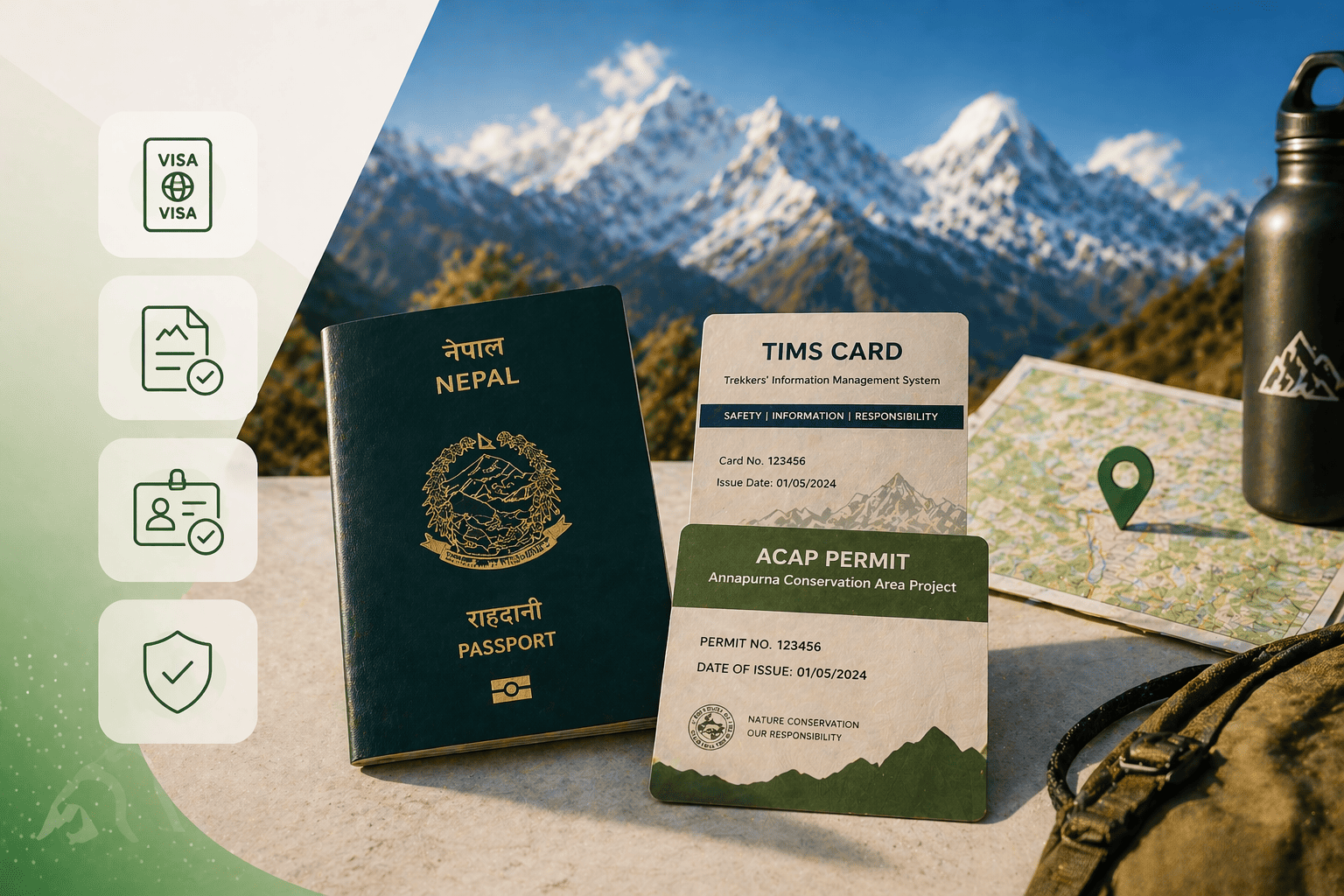
Nepal Visa, Annapurna Entry and Permits
Everything you need to enter Nepal and travel in the Annapurna region. Visa, conservation permits, restricted area permits, and documents explained.
Note: The following information are updated on April 2025. Visa fees, permit costs, and entry regulations are set by the Government of Nepal and may change without prior notice. Always verify the latest requirements before booking. Contact our team or visit immigration.gov.np for current information.
1. Nepal Visa Requirements
Most foreign nationals can obtain a Tourist Visa on Arrival at Tribhuvan International Airport (Kathmandu) or at designated land border crossings. No prior application is needed for eligible countries.
Visa Fees (Updated: April 2026)
Duration | Fee |
|---|---|
15 days | $30 USD |
30 days | $50 USD |
90 days | $125 USD |
All tourist visas are multiple-entry. Maximum stay is 150 days per calendar year. Visas can be extended at the Department of Immigration offices in Kathmandu or Pokhara.
What You Need at the Airport
A passport valid for at least 6 months from your date of arrival, one recent passport-sized photo (digital photo taken at kiosk is also accepted), visa fee in USD cash (card machines exist but are unreliable), and a completed visa application form (fill online before arrival at immigration.gov.np or use kiosk machines at the airport).
Pro tip: Fill the online form at the Department of Immigration website before your flight. You'll get a submission receipt with a barcode that lets you skip the kiosk queue at the airport. The receipt is valid for 15 days.
Who Gets Free Visa?
SAARC nationals (India, Bangladesh, Bhutan, Sri Lanka, Pakistan, Maldives) receive a free visa for up to 30 days for their first visit in a given visa year. Indian citizens do not require a visa at all under the 1950 Indo-Nepal Treaty and can enter with a valid Indian passport or Voter ID card.
Who Cannot Get Visa on Arrival?
Citizens of certain countries must obtain a visa from a Nepalese Embassy before arrival. As of 2026, these include Nigeria, Ghana, Zimbabwe, Swaziland, Cameroon, Somalia, Liberia, Ethiopia, Iraq, Palestine, Afghanistan, and Syria. Always check the latest list before travel.
Official Links
Nepal Department of Immigration (visa info and online form): immigration.gov.np
Nepal Tourist Visa page: immigration.gov.np/en/page/tourist-visa
Visa on Arrival details: immigration.gov.np/en/page/visa-on-arrival
Nepal Tourism Board: https://ntb.gov.np/
2. Entry Permits for the Annapurna Region
Different areas within the Annapurna region require different permits. Below is a breakdown by destination.
ACAP (Annapurna Conservation Area Permit)
This is the primary permit required for all trekking and touring within the Annapurna Conservation Area. It is mandatory and strictly enforced at multiple checkpoints.
Nationality | Fee |
|---|---|
Foreign nationals | NPR 3,000 (~$25 USD) |
SAARC nationals | NPR 1,000 (~$8 USD) |
Children under 10 | Free |
Where to get it: Nepal Tourism Board offices in Kathmandu (Bhrikutimandap) or Pokhara (Damside, near Phewa Lake). Can also be arranged through a registered trekking agency.
Documents needed: Passport copy, 2 passport-sized photos, completed application form, and permit fee in cash.
TIMS Card (Trekkers' Information Management System)
The TIMS card is a trekker registration system for safety and tracking purposes. Its enforcement has varied in recent years. As of 2026, TIMS is still recommended for most Annapurna treks, though ACAP is the strictly enforced permit.
Type | Fee |
|---|---|
Group trekkers (foreign) | NPR 1,000 (~$8 USD) |
Independent trekkers (foreign) | NPR 2,000 (~$15 USD) |
SAARC nationals (group) | NPR 300 |
SAARC nationals (independent) | NPR 600 |
Where to get it: Nepal Tourism Board or TAAN offices in Kathmandu or Pokhara.
Note: Permit requirements can change. We monitor the latest regulations and handle all permit arrangements as part of your package.
Restricted Area Permit (Upper Mustang)
Upper Mustang is a restricted area requiring a special permit that can only be obtained through a registered trekking agency. Permit Fees: After 2025, the minimum fee of 10 days is now replaced by a cost of USD 50 per day per person, which is the combined cost of 500 USD in 2025. This allows making the permit more flexible for shorter or longer hikes.
Duration | Fee |
|---|---|
First 10 days | $500 USD per person |
Each additional day | $50 USD per day |
A minimum of 2 trekkers was previously required, but as of March 2026, solo trekkers can now obtain restricted area permits with a licensed guide. A licensed guide booked through a TAAN-registered agency is mandatory.
3. Permits by Trek / Tour / Destination
Annapurna Base Camp Trek
ACAP: Required (NPR 3,000 for foreigners)
TIMS: Recommended
Checkpoints: Birethanti, Chhomrong, and Machhapuchhre Base Camp
Ghorepani Poon Hill Trek
ACAP: Required
TIMS: Recommended
Checkpoints: Birethanti and Ghorepani
Mardi Himal Trek
ACAP: Required
TIMS: Recommended
Checkpoints: Kande area and along the Mardi trail
Khayer Lake and Khopra Ridge Trek
ACAP: Required
TIMS: Recommended
Checkpoints: Birethanti and Khopra area
Annapurna Circuit Trek (including Tilicho Lake)
ACAP: Required
TIMS: Recommended
Checkpoints: Besisahar/Bhulbhule, Chame, Manang, Muktinath, Jomsom
Note for Tilicho Lake detour: No additional permit beyond ACAP is needed. Tilicho Lake sits within the Annapurna Conservation Area.
Lower Mustang (Jomsom, Kagbeni, Muktinath)
ACAP: Required
TIMS: Recommended
No restricted area permit needed. Lower Mustang is within the standard Annapurna Conservation Area.
Upper Mustang (Lo Manthang)
ACAP: Required
Restricted Area Permit: Required ($500 USD for 10 days)
Must be arranged through a registered agency
Licensed guide mandatory
4. Permits for Cities, Towns, and Villages
Pokhara
No permits required. Open city. No entry restrictions.
Besisahar (Annapurna Circuit starting point)
No permits required for the town itself. ACAP and TIMS are checked at trail checkpoints beyond Besisahar.
Beni (gateway to Lower/Upper Mustang and Annapurna Circuit west)
No permits required for the town. Permits checked at trail checkpoints beyond Beni.
Kusma (Parbat district headquarters)
No permits required.
Dhampus Village
ACAP: Required (within Annapurna Conservation Area)
Accessible by short walk or drive from Pokhara
Australian Base Camp (Australian Camp)
ACAP: Required
Short walk from Dhampus or Kande
Ghandruk Village
ACAP: Required
Checkpoints between Nayapul and Ghandruk
Lwang Ghalel
ACAP: Required (within Annapurna Conservation Area)
A lesser-visited village accessible from Pokhara side
Ghale Gaun
No ACAP required (outside the Annapurna Conservation Area boundary)
No special permits needed. Accessible by road from Besisahar/Lamjung area.
5. Important Information
Licensed Guide Requirement
Since 2023, the Nepal government requires all foreign trekkers in the Annapurna region to trek with a licensed guide. Independent trekking without a guide is no longer permitted for foreign nationals on trekking routes. This rule applies to all ACAP-regulated trails. For city tours and village visits accessible by road (Pokhara, Dhampus by vehicle), a guide is not legally required but recommended.
Carry Physical Copies
Always carry printed copies of your ACAP permit and TIMS card. Digital copies on your phone may not be accepted at checkpoints, especially in areas with no connectivity. Carry 2 to 3 photocopies of your passport and Nepal visa as backup.
Permit Validity
ACAP permits and TIMS cards are valid for the full duration of your trek. You do not need to renew them mid-trek. However, your trekking route must match what is stated on your permit. If you change your route significantly, inform your agency.
Checkpoints
There are multiple checkpoints along every trekking route where officials will inspect your permits. Key checkpoints include Birethanti (ABC/Poon Hill trails), Besisahar/Bhulbhule (Annapurna Circuit), Chhomrong (ABC trail), Chame and Manang (Circuit), and Jomsom/Kagbeni (Mustang entry). Trekking without valid permits can result in fines (typically double the permit fee) or being turned back.
Travel Insurance
Comprehensive travel insurance is mandatory for all trekking activities. Your policy should cover medical emergencies, emergency helicopter evacuation (costs can exceed $5,000 USD), trip cancellation, and loss of belongings. For Upper Mustang or high-altitude treks, ensure your policy covers the maximum altitude of your route.
USD Cash Quality
If paying visa or permit fees in USD cash, bring newer bills (Series 2013 or later) in clean, undamaged condition. Torn, faded, or marked bills are frequently rejected at both airport immigration and permit offices.
Seasonal Considerations
Permit offices in Kathmandu and Pokhara can be crowded during peak trekking seasons (October to November and March to May). Arriving early in the morning speeds up processing. If you book with a trekking agency, they handle all permits and you avoid the queues entirely.
We Handle Everything
When you book with Discover Annapurna, all permits, visa guidance, and documentation are arranged as part of your package. You provide a passport copy and photos. We handle the rest.
Permit fees and regulations are subject to change by the Government of Nepal. This page reflects the latest information as of 2026. For the most current requirements, check the official Nepal Department of Immigration and Nepal Tourism Board websites, or contact our team at contact@discoverannapurna.com.
