
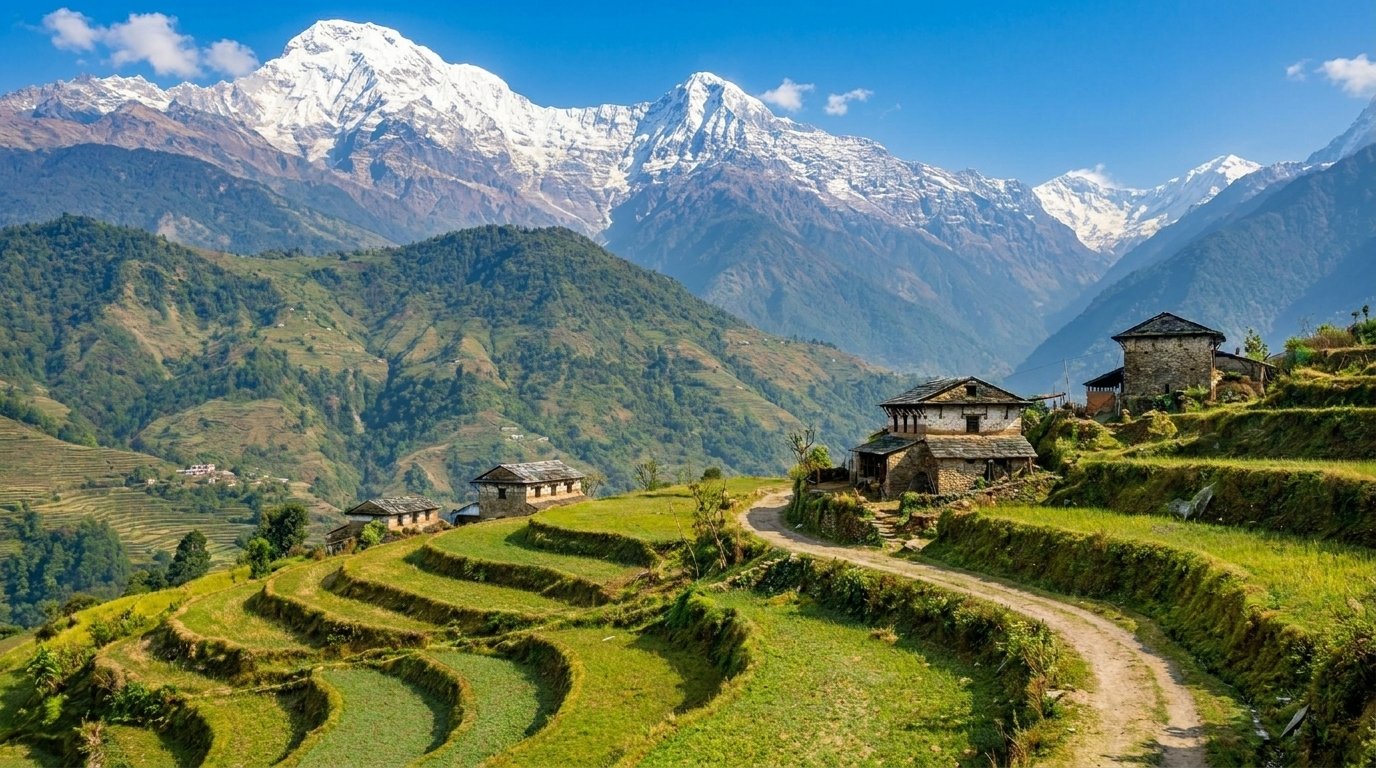
"Beginner guide permits, fitness, best season, what to pack, what to expect"
The Annapurna region is one of the most popular trekking destinations on the planet, and for good reason. It offers everything from gentle village walks to extreme high-altitude passes, all within a single protected area in central Nepal. Over 170,000 trekkers visit every year.
But if it's your first time, the planning can feel overwhelming. Permits, seasons, fitness, gear, altitude, food, safety — there's a lot to figure out before you set foot on the trail.
This guide covers everything you need to know before your first trek in the Annapurna region. No fluff, just the practical information that will actually help you prepare.
Where Exactly Is the Annapurna Region?
The Annapurna region sits in central Nepal, spreading across more than 7,600 square kilometers of protected land known as the Annapurna Conservation Area (ACA). It's named after Annapurna I, the tenth-highest mountain in the world at 8,091 meters.
The gateway city is Pokhara — Nepal's most visited city, located about 200 kilometers west of Kathmandu. You can reach Pokhara by a 25-minute domestic flight or a 6–7 hour scenic drive from Kathmandu. Most treks in the region start and end from Pokhara or nearby trailheads like Nayapul, Besisahar, or Jomsom.
Unlike more remote trekking regions in Nepal, the Annapurna area is relatively accessible. You can be on the trail within a few hours of arriving in Pokhara.
When Is the Best Time to Go?
Nepal has two prime trekking seasons, and both work well for the Annapurna region.
Autumn (October – November) is the most popular window. The monsoon has just ended, the skies are clear, the air is crisp, and mountain visibility is at its best. Trails are busy during this period, especially on popular routes like the Annapurna Base Camp trek and Poon Hill.
Spring (March – May) is the second-best season. Temperatures are warmer, the rhododendron forests are in full bloom (especially at mid-altitudes around 2,500–3,500m), and the trails are slightly less crowded than autumn. Visibility is generally good, though late afternoon clouds can roll in.
Winter (December – February) is possible for lower-altitude treks like Poon Hill or Ghandruk, but higher routes like the Annapurna Circuit and Base Camp can be extremely cold, with snow blocking passes like Thorong La.
Monsoon (June – September) is generally not recommended. Heavy rainfall makes trails slippery and dangerous, leeches are common, and mountain views are mostly obscured by clouds.
Which Trek Should You Choose?
The Annapurna region offers treks for every level. Here are the most popular options for first-timers.
Ghorepani Poon Hill Trek (5–7 days) is the best starting point if you've never trekked before. The altitude stays below 3,300 meters, the trails are well-maintained, and the sunrise view from Poon Hill — a panoramic sweep of the Annapurna and Dhaulagiri ranges — is one of the most iconic in Nepal. Physical difficulty is moderate.
Annapurna Base Camp Trek (10–14 days) is the most popular trek in the region. You walk into a natural amphitheatre surrounded by peaks over 7,000 meters, with Annapurna I towering above at 8,091 meters. The highest point is 4,130 meters. It requires a moderate-to-good level of fitness and some preparation for altitude.
Mardi Himal Trek (5–7 days) is a quieter alternative that's gained popularity in recent years. The trail offers stunning close-up views of Machhapuchhre (Fishtail) and the Annapurna range without the crowds of ABC or Poon Hill. It reaches around 4,500 meters at the high camp.
Annapurna Circuit Trek (12–18 days) is the classic long-distance trek. It takes you through subtropical forests, terraced farmlands, arid high desert, and over Thorong La Pass at 5,416 meters — one of the highest trekking passes in the world. This trek requires good fitness and proper acclimatization planning.
If you're unsure, start with Poon Hill or Mardi Himal. Both give you a genuine Himalayan experience without demanding extreme fitness or high-altitude experience.
What Permits Do You Need?
Every trekker in the Annapurna region needs two permits.
ACAP (Annapurna Conservation Area Permit) costs approximately $30 USD for foreign nationals. This permit supports conservation efforts across the region.
TIMS (Trekkers' Information Management System) card costs approximately $20 USD. It's a registration system that tracks trekkers for safety purposes.
Both permits can be obtained in Kathmandu (at the Nepal Tourism Board office) or in Pokhara (at the tourism office near the lakeside). If you book with a trekking company, they will typically arrange all permits for you as part of the package.
Some specific areas like Upper Mustang require additional restricted area permits, which are significantly more expensive and must be arranged through a registered agency.
How Fit Do You Need to Be?
This is the question everyone asks, and the honest answer is: it depends on the trek.
For Poon Hill or Ghandruk, you need basic fitness. If you can walk for 5–6 hours a day on uneven terrain with some uphill sections, you'll be fine. No prior trekking experience is needed.
For Annapurna Base Camp, moderate fitness is recommended. You'll be walking 5–7 hours a day, often on steep stone steps, and sleeping at altitudes above 3,000 meters. Regular cardio exercise (jogging, cycling, swimming, or hiking) for at least 4–6 weeks before departure will make a significant difference.
For the Annapurna Circuit, good cardiovascular fitness is important. The trek involves long days, significant elevation gain, and crossing Thorong La at 5,416 meters. Start training at least 6–8 weeks before your trip. Include stair climbing, uphill walking with a loaded backpack, and some endurance work.
Regardless of the trek, the single most important factor is pace. Trekking in the Himalayas is not a race. Walking slowly, staying hydrated, and listening to your body will get you further than raw fitness.
What Should You Pack?
Packing for Annapurna depends on the season and altitude, but here are the essentials that apply to most treks.
Clothing: Layering is key. A moisture-wicking base layer, an insulating mid-layer (fleece or down jacket), and a waterproof outer shell. Trekking pants (convertible ones are useful), a warm hat, gloves, and a buff or neck gaiter for higher altitudes.
Footwear: Broken-in trekking boots with ankle support. Do not buy new boots the week before your trek. Bring a pair of lightweight sandals for tea house evenings.
Gear: A good-quality sleeping bag rated for at least -10°C (for higher altitude treks), a 30–40 liter daypack or a 50–60 liter pack if carrying your own gear, trekking poles (highly recommended for knee protection on descents), a headlamp with spare batteries, and a refillable water bottle.
Other essentials: Sunscreen (SPF 50+), sunglasses with UV protection, a basic first-aid kit, altitude sickness medication (Diamox — consult your doctor before the trek), personal toiletries, and quick-dry towels.
Most trekkers in the Annapurna region stay in tea houses (lodges), so you don't need to carry tents or cooking equipment. You can also hire porters to carry your main bag, which means your daypack only needs to hold water, snacks, a rain jacket, and a camera.
What About Altitude Sickness?
Altitude sickness (Acute Mountain Sickness or AMS) is a real risk on any trek that goes above 2,500 meters. It happens when your body doesn't have enough time to adjust to reduced oxygen levels at higher elevations.
Common symptoms include headache, nausea, dizziness, fatigue, and difficulty sleeping. In serious cases, it can progress to life-threatening conditions like HACE (High Altitude Cerebral Edema) or HAPE (High Altitude Pulmonary Edema).
The golden rule is simple: ascend gradually. Above 3,000 meters, your sleeping altitude should not increase by more than 300–500 meters per day, and you should build in rest days every 3–4 days.
Stay hydrated, avoid alcohol at altitude, eat carbohydrate-rich meals, and never push through serious symptoms. If symptoms worsen, the only reliable treatment is to descend immediately.
Many trekkers carry Diamox (Acetazolamide) as a preventive measure. It helps your body acclimatize faster, but it's not a substitute for proper ascent planning. Consult your doctor before taking it.
Your guide will monitor the group for altitude symptoms and adjust the itinerary if needed. This is one of the key reasons trekking with an experienced local guide is recommended, especially on routes that go above 4,000 meters.
What Will You Eat?
Food in the Annapurna region is better than most first-timers expect. Tea houses along the trail serve hot meals twice a day (lunch and dinner) plus breakfast.
The staple is dal bhat — lentil soup with rice, vegetables, and pickles. It's filling, nutritious, and you can get unlimited refills at most tea houses. You'll also find momos (Nepali dumplings), noodle soups, fried rice, pasta, pancakes, and eggs on most menus.
At higher altitudes, menus become simpler and prices increase (food has to be carried up by porters or mules). Stick to cooked food, avoid salads and raw vegetables above 3,000 meters, and drink plenty of hot tea or boiled water.
If you have dietary restrictions (vegetarian, vegan, gluten-free), you'll generally be fine. Dal bhat is naturally vegetarian, and most tea houses can accommodate basic requests.
Is It Safe?
The Annapurna region is generally very safe for trekkers. The trails are well-established, tea houses are plentiful on popular routes, and the local communities along the trail are welcoming.
That said, the mountains demand respect. Weather can change rapidly, trails can be affected by landslides during monsoon season, and altitude sickness is always a factor on higher treks.
To stay safe: trek with a licensed guide (especially above 4,000m), carry travel insurance that covers emergency helicopter evacuation, keep your permits and identification accessible, and always inform your guide or tea house owner of your plans.
Mobile phone coverage is available on most popular trails up to moderate altitudes, though it can be spotty. Wi-Fi is available at many tea houses for a small fee, but don't rely on it.
Do You Need a Guide?
Technically, independent trekking is allowed in the Annapurna Conservation Area (unlike some restricted regions). However, hiring a local guide is strongly recommended, especially for first-timers.
A good guide doesn't just show you the trail — they manage logistics, handle permits, communicate with tea houses, monitor your health at altitude, and share local knowledge about the culture, geography, and history of the places you walk through.
If you're on a budget, you can hire a guide-porter (a single person who carries your bag and guides you) for a lower cost than hiring both separately.
How Much Does It Cost?
Costs vary widely depending on the trek, duration, and package tier (group, private, comfort, luxury). As a rough guideline for the Annapurna region:
Budget/standard packages typically start from $800–$1,200 USD for a 10–14 day trek including permits, guide, accommodation, and meals on the trail.
Private and comfort packages with better lodges, more personalized service, and flexible itineraries range from $1,500–$3,000 USD.
Premium and luxury packages with helicopter transfers, boutique lodges, and full concierge service can go above $4,000 USD.
These are indicative ranges. The best approach is to share your dates, group size, and preferences with a local operator who can build a detailed quote.
Final Advice
The Annapurna region rewards those who show up prepared but open. Don't over-plan every detail — some of the best moments on the trail are the ones you didn't expect. A conversation with a tea house owner. A sudden break in the clouds revealing a peak you didn't know was there. A plate of dal bhat that tastes better than any meal you've had.
Start with a trek that matches your fitness. Trust your guide. Walk slowly. And let the mountains do what they've been doing for millions of years — put everything else in perspective.
Have questions about planning your first Annapurna trek? Our local team is based in Pokhara and ready to help. Reach out at contact@discoverannapurna.com or start a conversation on our website.
Want to read this offline or share with a friend?
Super Admin
Travel Specialist & Author
Adventure enthusiast and explorer sharing insights from the heart of the Himalayas. Focus on making mountain travel accessible and safe for everyone on the Gomayu platform.

Discussion (0)
Write CommentNo comments yet. Be the first to join the discussion!
Leave a response