
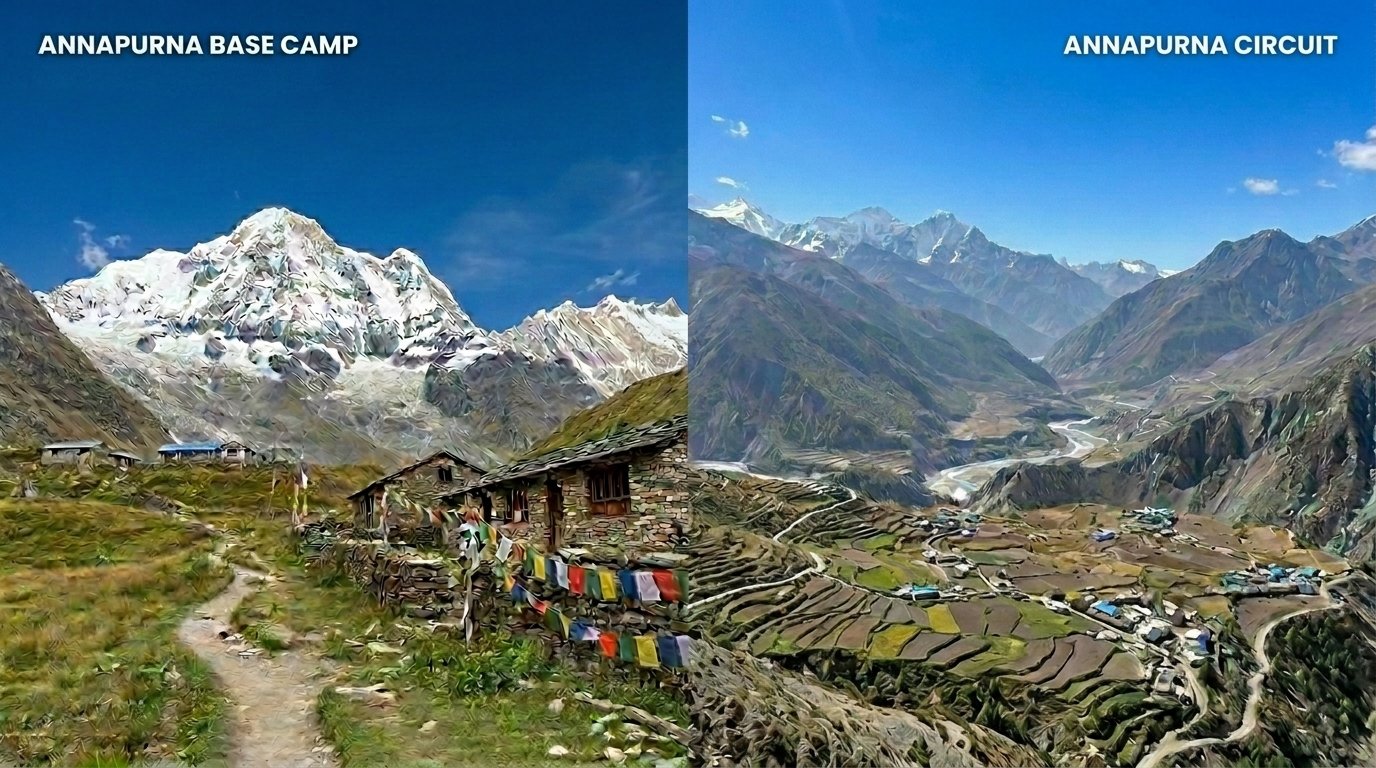
"Two iconic treks, one region. Here's how to decide which one fits your time, fitness, and travel style."
The Annapurna Base Camp (ABC) trek and the Annapurna Circuit are two of the most famous treks in the world. Both are in the same region, both deliver world-class Himalayan scenery, and both attract thousands of trekkers every year.
But they are very different experiences.
One takes you deep into a mountain amphitheatre. The other takes you around an entire massif, crossing one of the highest trekking passes on Earth. Choosing between them depends on your available time, fitness level, what kind of experience you're after, and how much variety you want from a single trek.
This guide breaks down every factor so you can make the right call.
The Quick Comparison
Before diving into details, here's the overview.
Annapurna Base Camp is a shorter, more focused trek that ends in a dramatic natural amphitheatre surrounded by 8,000-meter peaks. It's the better choice if you have limited time and want a powerful mountain experience without crossing extreme altitude passes.
The Annapurna Circuit is a longer, more diverse journey that loops around the entire Annapurna massif. It crosses through forests, farmlands, high desert, and over Thorong La Pass at 5,416 meters. It's the better choice if you have more time and want variety in landscape, culture, and terrain.
Duration
Annapurna Base Camp: 10 to 14 days, including travel days from and to Kathmandu or Pokhara. The actual trekking portion is typically 7 to 10 days depending on your route and pace.
Annapurna Circuit: 12 to 20 days, depending on whether you do the full classic route or a shortened version. Most trekkers take 14 to 17 days including travel days. Adding side trips like Tilicho Lake or Ice Lake extends the duration.
Verdict: If you have two weeks or less, ABC is the practical choice. If you have three weeks, the Circuit gives you a far more expansive experience.
Difficulty and Fitness
Annapurna Base Camp reaches a maximum altitude of 4,130 meters. The trail involves long days of 5 to 7 hours, with significant stone staircase sections (especially the climb to Chhomrong and the descent to Jhinu Danda). The altitude gain is gradual, and most trekkers with moderate fitness handle it well. The main challenge is the relentless stone steps, which are tough on the knees.
Annapurna Circuit reaches 5,416 meters at Thorong La Pass. This is a serious high-altitude crossing that requires proper acclimatization, good cardiovascular fitness, and mental preparation. The daily walking hours are similar (5 to 7 hours), but the trek is longer and the terrain is more varied. The pass day itself is demanding: an early morning start, steep ascent, and a long descent to Muktinath on the other side.
Verdict: ABC is moderate. The Circuit is moderate to challenging, primarily because of Thorong La. If you've never been above 4,000 meters before, ABC is the safer introduction to high-altitude trekking.
Scenery and Landscape
Annapurna Base Camp delivers one unforgettable payoff. The trek moves through terraced farmlands, dense rhododendron and bamboo forests, and river valleys before opening up into the Annapurna Sanctuary. The final destination is a natural amphitheatre with a 360-degree wall of peaks including Annapurna I (8,091m), Annapurna South, Machhapuchhre (Fishtail), Hiunchuli, and Gangapurna. The sunrise at ABC is one of the most iconic moments in Himalayan trekking.
Annapurna Circuit delivers variety. You start in subtropical lowlands with rice paddies and banana trees. The landscape shifts to temperate forests, then alpine meadows, then the arid high desert of Manang and Upper Mustang's fringes. Crossing Thorong La, you descend into the rain shadow of the Himalayas, a completely different world of dry, barren terrain with Tibetan Buddhist culture. No other single trek in Nepal shows you this range of environments.
Verdict: ABC wins on dramatic impact at a single destination. The Circuit wins on diversity across the entire journey. If you want "the moment," go ABC. If you want "the journey," go Circuit.
Culture and Villages
Annapurna Base Camp passes through Gurung villages like Ghandruk and Chhomrong. These are beautiful settlements with stone houses, traditional culture, and warm hospitality. But the cultural exposure is relatively contained since most of the trek moves through forested areas and narrow river valleys.
Annapurna Circuit is a cultural journey as much as a mountain one. You pass through Gurung, Manangi, and Thakali communities. The eastern side is lush and Hindu-influenced. As you cross to the western side via Thorong La, the culture shifts dramatically to Tibetan Buddhist traditions. Muktinath, a sacred temple at 3,710 meters, is a pilgrimage site for both Hindus and Buddhists. The villages of Manang, Marpha, and Kagbeni each have distinct character and architecture.
Verdict: The Circuit offers significantly more cultural depth and variety.
Accommodation and Tea Houses
Annapurna Base Camp has well-established tea houses along the entire route. At lower altitudes, lodges are comfortable with private rooms, hot showers, and decent menus. As you climb higher toward Deurali and ABC, facilities become more basic. Rooms are shared dormitory-style at the highest points, and hot showers may not be available.
Annapurna Circuit also has tea houses throughout, but quality varies more widely. The eastern section (Besisahar to Manang) has simple but functional lodges. Manang itself has better options. On the western side (Muktinath to Jomsom to Tatopani), there are more comfortable lodges, especially in towns like Marpha and Jomsom. Luxury and comfort lodge options exist on certain sections of the Circuit for those who want a higher-end experience.
Verdict: Similar overall. Both offer a range from basic to comfortable. The Circuit has slightly more variation in lodge quality.
Food on the Trail
Both treks share a similar menu at tea houses. Dal bhat (lentil soup with rice) is the staple and is available everywhere. You'll also find momos, noodle soups, fried rice, eggs, pancakes, and basic pasta dishes.
The key difference is that the Annapurna Circuit passes through Thakali villages, particularly Marpha and Tukuche, which are known across Nepal for their cuisine. Thakali dal bhat with its distinctive flavors and variety of side dishes is considered some of the best food on any trekking route in the country. The apple orchards around Marpha also produce fresh apple pie, apple cider, and apple brandy that are local specialties.
Verdict: The Circuit edges ahead for food variety, especially in the Thakali region.
Cost
Annapurna Base Camp is generally less expensive because it's shorter. Standard group packages typically range from $800 to $1,200 USD. Private and comfort packages run from $1,500 to $2,500 USD.
Annapurna Circuit costs more due to the longer duration. Standard packages range from $1,000 to $1,800 USD. Private packages with comfort lodges and side trips can go from $2,000 to $4,000+ USD. Additional permits may be required if you add side trips to restricted areas.
Both treks require the same base permits (ACAP and TIMS), so permit costs are identical.
Verdict: ABC is more budget-friendly due to shorter duration. The Circuit costs more but covers significantly more ground.
Best Season
Both treks share the same optimal seasons: October to November (autumn) and March to May (spring).
However, the Annapurna Circuit has an additional consideration. Thorong La Pass at 5,416 meters can be blocked by snow during winter and early spring. If you're trekking the Circuit in December, January, or early March, the pass crossing becomes risky or impossible. ABC's highest point (4,130m) is more accessible during shoulder seasons.
Verdict: ABC has a slightly wider trekking window. The Circuit requires more careful seasonal planning due to Thorong La.
Side Trips and Add-Ons
Annapurna Base Camp doesn't offer many side trip options. The trek follows a single valley in and out. Some trekkers combine it with Poon Hill as a pre-trek or post-trek addition, or add Mardi Himal for a combo experience.
Annapurna Circuit offers excellent side trips. Tilicho Lake (one of the highest lakes in the world at 4,919m), Ice Lake above Manang, and the Upper Mustang extension are all accessible detours. These add days to the trek but significantly enhance the experience.
Verdict: The Circuit wins decisively for side trip options.
Which One Is Right for You?
Choose Annapurna Base Camp if: You have 10 to 14 days. You want a focused, dramatic mountain experience. You're a first-time trekker or prefer moderate difficulty. You want the iconic 360-degree amphitheatre moment. You're trekking during a shoulder season when higher passes might be risky.
Choose the Annapurna Circuit if: You have 15+ days. You want maximum landscape and cultural variety. You're reasonably fit and comfortable with high-altitude trekking. You want to cross one of the world's highest passes. You want the option to add side trips like Tilicho Lake.
Choose both if: You have the time and fitness. Some trekkers do ABC first as an acclimatization trek, then tackle the Circuit. This is a 25 to 30-day commitment but gives you the complete Annapurna experience.
There's No Wrong Choice
Both treks are world-class. Both will challenge you, inspire you, and leave you with memories that last. The Annapurna Base Camp gives you one perfect destination. The Annapurna Circuit gives you an entire world.
The right choice is the one that matches your time, your body, and what you want from the mountains.
Need help deciding? Our local team in Pokhara has walked both routes and can help you choose based on your dates, fitness, and travel style. Reach out at contact@discoverannapurna.com.
Want to read this offline or share with a friend?
Super Admin
Travel Specialist & Author
Adventure enthusiast and explorer sharing insights from the heart of the Himalayas. Focus on making mountain travel accessible and safe for everyone on the Gomayu platform.

Discussion (0)
Write CommentNo comments yet. Be the first to join the discussion!
Leave a response